Believe In The BestMount Pleasant Brampton Real Estate Guide (2026)Prices, GO Transit access, and buyer trends in Brampton West's transit-oriented village communityGO Transit Access Modern Homes

Dated: February 24 2026
Views: 427
To build out your step-by-step home search strategy for the current market, review the master Brampton Real Estate Market First-Time Buyers Guide
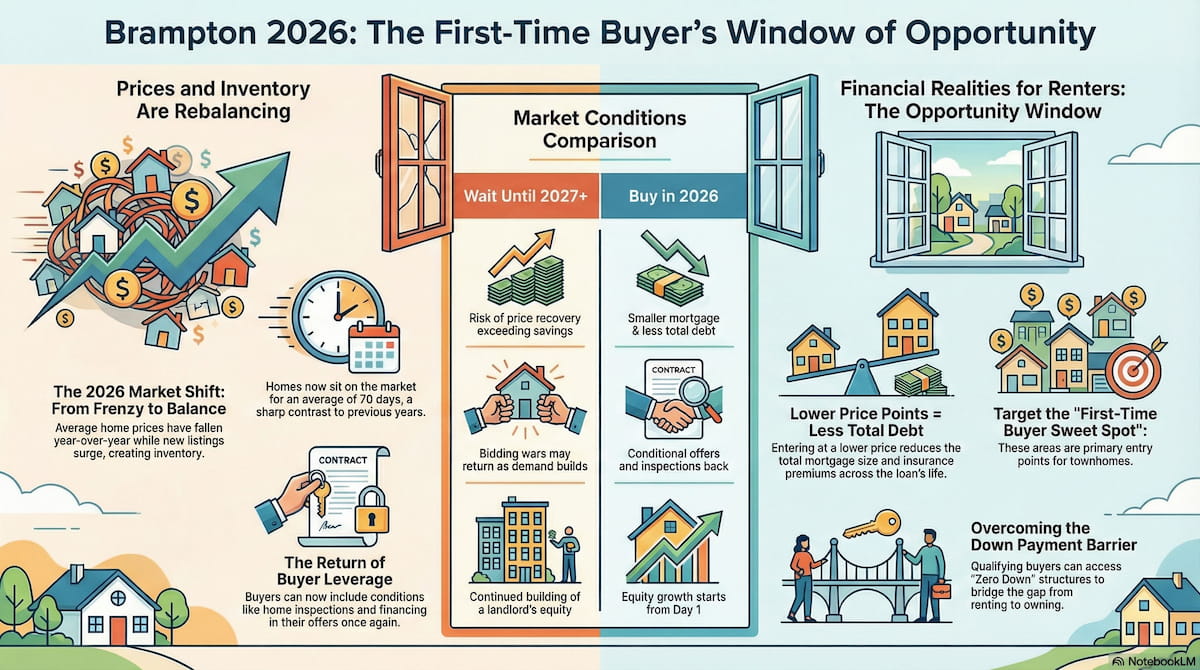
If you're a first-time home buyer in Brampton, the most important thing to understand in 2026 is this: the market you've been watching — and the one that may have put you off buying entirely — no longer exists. Average home prices have fallen 6.8% year-over-year across Brampton, listings have surged 64.4% since the start of 2026, and homes are now sitting on the market for an average of 70 days. That is a fundamentally different environment from the frenzy years of 2021 and 2022.
The mental benchmark most renters are carrying was formed in that frenzy: packed open houses, offers accepted the same weekend, prices that felt detached from any rational measure of value. That image stuck — and for many people it still shapes how they think about whether buying is even possible. But those conditions are gone, and the numbers today tell a very different story.
The correction has been most visible in exactly the property types first-time buyers target. Townhomes in the $600,000–$700,000 range — the primary entry point for Brampton's first-time buyer market according to current data — have seen meaningful price adjustments. The same is true for condos and entry-level semi-detached homes. What felt financially out of reach in 2022 has, in many cases, moved considerably closer.
The 2020–2022 Brampton market was the product of an unusual combination: record-low interest rates, pandemic-driven space demand, remote work shifting what buyers needed from a home, and a housing supply that could not respond quickly enough. Prices surged well beyond what long-term economic fundamentals could sustain — and buyers caught in the middle of that frenzy paid accordingly.
When the Bank of Canada began raising interest rates aggressively from 2022 onward, that combination unwound quickly. By 2025, the average Brampton sale price had dropped 6.8% year-over-year and total listings had grown by nearly 20%. Demand softened. The sellers' market gave way to something far more balanced — and heading into 2026, with 5.6 months of available inventory and homes taking 70 days to sell on average, buyers now have more choice and leverage than they've had in nearly a decade.
In 2026, that adjusted market is the one first-time buyers are actually entering. And within it, the conditions are meaningfully more favourable than most renters assume.
The three neighbourhoods drawing the most first-time buyer attention in 2026 are Mount Pleasant, Heart Lake, and Bramalea — identified as Brampton's top areas for entry-level buyers this year. Mount Pleasant offers strong transit access via the GO station and solid walkability. Heart Lake appeals to buyers who want more space and outdoor access. Bramalea is one of Brampton's most established communities with a broad mix of housing types and long-term stability.
Across these areas and others, semi-detached homes are expected to see the strongest first-time buyer demand in 2026, with townhomes in the $600,000–$700,000 range representing the primary entry point into the market. These are real homes in real neighbourhoods — not compromises on the edges of the city.
Before diving into specific Bramalea neighborhoods, check out our complete
Across Brampton, homes are sitting on the market longer than they did at the peak. That shift in supply and demand has given buyers something they simply did not have in 2021: leverage.
Conditional offers — subject to financing, subject to a home inspection — are back on the table. Buyers can properly evaluate a property before committing, walk away if something doesn't feel right, and negotiate on price and closing terms. For several years, buying without conditions was the only way to compete. That is no longer the case, and it represents a significant reduction in the risk carried by first-time buyers entering the market.
The conversation most buyers have about affordability focuses on monthly payments — and rates, in that context, matter a great deal. But there is a second dimension that often goes undiscussed: the total size of the mortgage.
A home purchased today at a lower price — even with a higher rate — carries a smaller mortgage than the same home purchased at a higher price during the low-rate years. That matters across the full life of the loan, not just month to month. It also means a smaller mortgage insurance premium for buyers putting down less than 20%, since those premiums are calculated as a percentage of the loan amount.
When rates eventually ease — as economic cycles suggest they will — buyers who entered at a lower price point can refinance downward. There is no equivalent mechanism for retroactively reducing an inflated purchase price. The entry point is often more durable than the rate.
Brampton is one of the fastest-growing cities in Canada. Immigration, infrastructure development, and sustained population growth continue to underpin long-term demand for housing in ways that short-term rate cycles simply cannot permanently suppress.
Historically, the buyers who fare best in the GTA are not those who timed the absolute bottom of the market. They are the ones who entered during a period of relative calm — when prices had adjusted, competition had eased, and the long-term trajectory of the area remained clearly upward. The current Brampton environment fits that description well.
There is a version of patience that is genuinely sound financial thinking: saving deliberately, building credit, and waiting until the right conditions align. That approach has real merit.
But there is another version of waiting that tends to go unexamined — the ongoing financial cost of renting while the decision to buy gets deferred year after year.
Every month a renter pays rent, they are servicing someone else's mortgage. The equity accumulating in that property belongs to the landlord. The appreciation — if and when values recover — belongs to the landlord. The tenant's financial position does not benefit from any of this.
Rents in Brampton have not been standing still. The same supply and demand dynamics that make purchasing feel difficult are also pushing rental costs upward. The monthly gap between what a typical Brampton renter pays and what a mortgage payment on a comparable entry-level home would cost is, in many cases, narrower than most renters expect. In some situations, total monthly ownership costs — mortgage, property tax, and maintenance — are comparable to prevailing rents for similar properties.
The point is not that buying is always the right move. The point is that the assumption that renting is the safe, low-cost default — while buying carries all the financial risk — deserves to be examined more carefully than most people examine it.
Ask most Brampton renters what is stopping them from buying, and the answer is almost always the same: the down payment. Not income. Not credit. The upfront cash.
It is a legitimate obstacle. Saving 5% to 20% of a $600,000+ property while paying Brampton rents takes years for most people — years during which the market can shift, rents can climb, and saving targets can feel like they keep moving further away.
What tends to be less understood is that the down payment barrier, while real, is not always as fixed as people assume. How savings, assets, and income are currently structured can make a significant difference to what is actually available to a buyer. There are also lending structures and brokerage-specific programmes — including a Zero Down Programme offered through our brokerage — that can meaningfully change the picture for buyers who qualify.
The details of those structures matter, and whether any of them apply to a specific situation depends on the full financial picture. But the broader point is worth holding on to: the conversation about the down payment is worth having before concluding the answer is simply 'not yet.'
Struggling to accumulate upfront cash while renting? Read our step-by-step breakdown on
Based on current market data, yes — 2026 presents conditions meaningfully more favourable for first-time buyers than the peak years of 2021–2022. Prices have corrected, inventory has surged, and buyers now have genuine negotiating leverage including conditional offers and time to properly evaluate properties. Whether it is the right time for any individual depends on their specific financial situation, but the market itself is the most buyer-friendly it has been in years.
As of January 2026, the average home price across all property types is $882,710. For first-time buyers, the most active range is $600,000–$700,000, covering townhomes and entry-level semi-detached homes in Mount Pleasant, Heart Lake, and Bramalea. Detached homes average around $1,021,192.
There are options available to first-time buyers in Ontario that can reduce the upfront cash required. The right combination depends on income, credit, and savings structure. Our brokerage also offers a Zero Down Programme for qualified buyers — a lender-compliant structure that can significantly reduce the down payment barrier. More information is available on our website.
Renting around the Madoc or Hansen Road area and looking to transition into ownership without waiting years to save a full deposit? Check out our localized breakdown on
As of January 2026, homes are taking an average of 70 days to sell — up from 60 days in December 2025. For buyers, this means more time to evaluate properties, conduct inspections, and negotiate — conditions that barely existed two or three years ago.
Mount Pleasant, Heart Lake, and Bramalea are drawing the most first-time buyer interest in 2026. Mount Pleasant offers GO Transit access and walkability. Heart Lake suits buyers wanting more space. Bramalea is established with a broad housing mix. Semi-detached homes and townhomes in the $600,000–$700,000 range are the primary entry-level inventory across these areas.
This market guide is published by Royal Canadian Realty Brokerage, serving first-time buyers across Brampton, Mississauga, Caledon, and the surrounding GTA. Our focus is on giving renters an honest, data-grounded view of the local market — not a sales pitch, but the kind of context that makes it possible to make well-informed decisions about one of the most significant financial moves a person can make.
We work with buyers at every stage: those ready to move now, those building toward a purchase 6–12 months from now, and those who simply want to understand the landscape clearly before making any commitments. The market insight, buyer guides, and information on how our Zero Down Programme works for qualified buyers are all available on our website — written in plain language, without the pressure of a sales conversation.
If this guide has been useful, there is considerably more where it came from. The Brampton market in 2026 has more nuance than any single article can cover — and understanding your specific situation within it is what turns general insight into a real plan.
DISCLAIMER: This article is published for general informational purposes only and does not constitute financial, legal, mortgage, or tax advice. Market statistics sourced from Zoocasa, RE/MAX, and WOWA (January–February 2026). All lending eligibility and programme availability is subject to individual qualification and lender approval. Readers should seek independent professional advice before making any financial or property decisions.

Your Local Buyer’s Real Estate Agent in Brampton and MississaugaBuying a home is more than just a transaction — it’s a major life decision. As a Realtor focused on helping home buyer....
Believe In The BestMount Pleasant Brampton Real Estate Guide (2026)Prices, GO Transit access, and buyer trends in Brampton West's transit-oriented village communityGO Transit Access Modern Homes
Tired of Renting in Bramalea? How to Buy Your First Home Near Bramalea City Centre with Zero Down (2026 Guide)A practical roadmap for renters near Bramalea City Centre, Central Park Drive, Clark
Helping qualified Queen Street Corridor renters explore a path from renting to homeownership in Brampton through Royal Canadian Realty's Zero Down Homeownership Program.Brampton First-Time Buyers
Royal Canadian Realty, Brokerage • "Believe In The Best"Brampton Buyer Guide · 2026First-Time Buyer Guide to Heart Lake, Brampton (2026): Prices, Schools & Top
 Toronto Real Estate Board (TRREB); All information deemed reliable but not guaranteed. All properties are subject to prior sale, change or withdrawal. Neither listing broker(s) or information provider(s) shall be responsible for any typographical errors, misinformation, misprints and shall be held totally harmless. Listing(s) information is provided for consumer's personal, non-commercial use and may not be used for any purpose other than to identify prospective properties consumers may be interested
in purchasing. The data relating to real estate for sale on this website comes in part from the Internet Data Exchange program of the Multiple Listing Service. Real estate listings held by brokerage firms other than Royal Canadian Realty, Brokerage, Mississauga may be marked with the Internet Data Exchange logo and detailed information about those properties will include the name of the listing broker(s) when required by the MLS. Copyright ©2026 All rights reserved.
Last Updated: September 24, 2026 12:48 PM UTC
Show More...
Toronto Real Estate Board (TRREB); All information deemed reliable but not guaranteed. All properties are subject to prior sale, change or withdrawal. Neither listing broker(s) or information provider(s) shall be responsible for any typographical errors, misinformation, misprints and shall be held totally harmless. Listing(s) information is provided for consumer's personal, non-commercial use and may not be used for any purpose other than to identify prospective properties consumers may be interested
in purchasing. The data relating to real estate for sale on this website comes in part from the Internet Data Exchange program of the Multiple Listing Service. Real estate listings held by brokerage firms other than Royal Canadian Realty, Brokerage, Mississauga may be marked with the Internet Data Exchange logo and detailed information about those properties will include the name of the listing broker(s) when required by the MLS. Copyright ©2026 All rights reserved.
Last Updated: September 24, 2026 12:48 PM UTC
Show More...
 All information deemed reliable but not guaranteed. All properties are subject to prior sale, change or withdrawal. Neither listing broker(s) or information provider(s) shall be responsible for any typographical errors, misinformation, misprints and shall be held totally harmless. Listing(s) information is provided for consumer's personal, non-commercial use and may not be used for any purpose other than to identify prospective properties consumers may be interested in purchasing. The data relating
to real estate for sale on this website comes in part from the Internet Data Exchange program of the Multiple Listing Service. Real estate listings held by brokerage firms other than Royal Canadian Realty, Brokerage, Mississauga may be marked with the Internet Data Exchange logo and detailed information about those properties will include the name of the listing broker(s) when required by the MLS. Copyright ©2026 All rights reserved.
Last Updated: September 24, 2026 5:35 AM UTC
Show More...
All information deemed reliable but not guaranteed. All properties are subject to prior sale, change or withdrawal. Neither listing broker(s) or information provider(s) shall be responsible for any typographical errors, misinformation, misprints and shall be held totally harmless. Listing(s) information is provided for consumer's personal, non-commercial use and may not be used for any purpose other than to identify prospective properties consumers may be interested in purchasing. The data relating
to real estate for sale on this website comes in part from the Internet Data Exchange program of the Multiple Listing Service. Real estate listings held by brokerage firms other than Royal Canadian Realty, Brokerage, Mississauga may be marked with the Internet Data Exchange logo and detailed information about those properties will include the name of the listing broker(s) when required by the MLS. Copyright ©2026 All rights reserved.
Last Updated: September 24, 2026 5:35 AM UTC
Show More...
