Believe In The BestMount Pleasant Brampton Real Estate Guide (2026)Prices, GO Transit access, and buyer trends in Brampton West's transit-oriented village communityGO Transit Access Modern Homes

Dated: January 7 2026
Views: 292
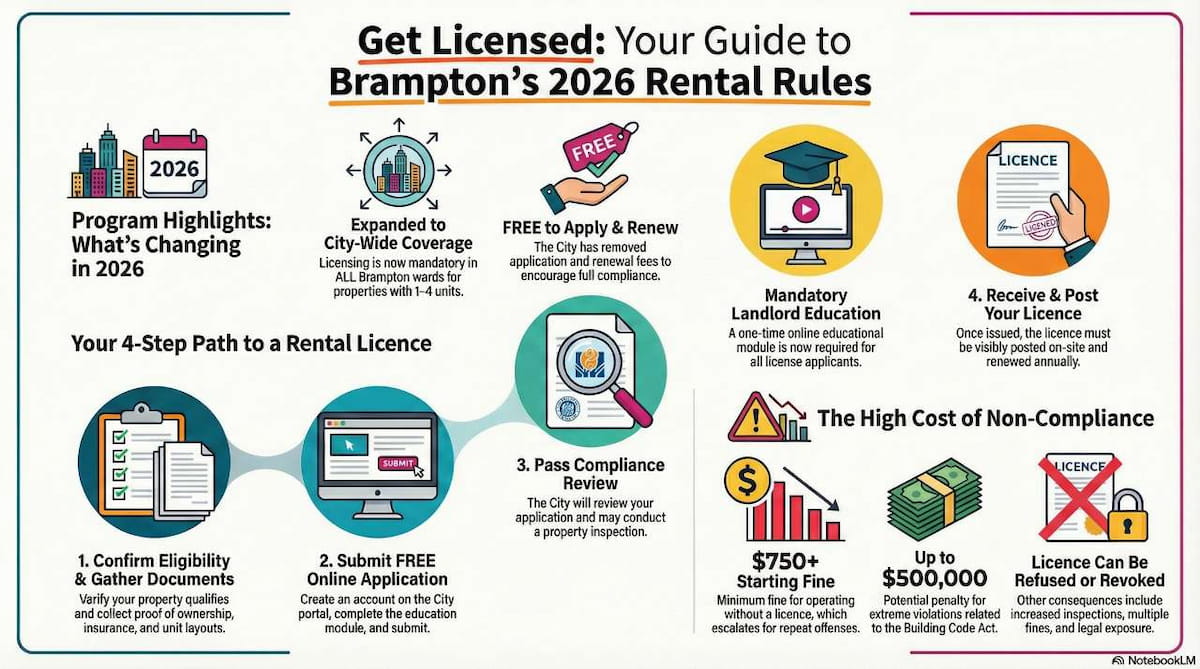
Landlords in Brampton now operate under a city‑wide rental licensing regime for most small‑scale residential rentals in Brampton, effective January 1, 2026, with non‑compliance exposing owners to fines and potential loss of the ability to rent legally. This updated framework significantly reshapes how small residential landlords manage their properties and is intended to provide stronger safety and transparency protections for tenants in every ward.
As of January 1, 2026, Brampton’s Residential Rental Licensing (RRL) Pilot Program has been expanded from a limited set of wards to all wards in the city. In general, small rental properties with 1–4 units across Brampton must now be licensed to be rented legally, including detached homes, semis, townhouses, duplexes, triplexes, fourplexes, and similar small rentals, subject to any detailed exceptions in the by‑law.
The 2026 update effectively moves the program from a localized pilot to a city‑wide framework with common expectations for landlords and tenants. The current version of the program is planned to run through December 31, 2028, giving the City several years to gather data, adjust enforcement, and decide on longer‑term regulation.
Key elements include:
Mandatory licensing: Licensing is required for most 1–4 unit residential rentals in every Brampton ward to operate legally, subject to specific by‑law definitions and exemptions.
Educational module: Applicants must complete a one‑time online educational module outlining landlord obligations, tenant rights, and City expectations around rental housing.
Standard conditions: Licences carry conditions tied to property standards, fire safety, insurance, and occupancy limits, which must be maintained on an ongoing basis.
No licence fee (currently): Applications and renewals are currently set with no fee to support compliance and reduce cost barriers, as reflected in recent Council direction for the expanded program.
The new rules make licensing a core requirement of owning and operating small residential rentals in Brampton, not just an issue for the original pilot wards. Landlords who were outside the initial pilot areas, including those in wards such as 2, 6, 8, 9, and 10, now need to treat licensing with the same seriousness as financing, insurance, and tax obligations.
Landlords can expect to:
Obtain and maintain a licence: A Residential Rental Licence in Brampton is required for each covered property with 1–4 units anywhere in Brampton.
Meet minimum standards: Building, fire, property standards, occupancy, and insurance requirements must be met and maintained for the licence to remain valid.
Complete education: A one‑time online educational module must be completed as part of the application process to clarify rights and responsibilities.
Keep information current: Contact and ownership information must be kept up to date with the City, including timely notice of changes, in line with program rules and by‑law timelines.
Once licensed, landlords are expected to:
Maintain property standards and safety features, including operational smoke alarms, clear exits, structural soundness, pest management, and general cleanliness.
Carry appropriate insurance, often with at least $2 million in liability coverage, as commonly required for small residential rentals.
Post the licence in a visible location within the rental unit or common area and make it available to tenants or inspectors on request.
Renew the licence annually, confirming that standards, insurance, and ownership information remain accurate and in compliance.
From a business standpoint, the regime pushes Brampton landlords toward a more professional, regulated model, where documentation, inspections, and compliance are non‑negotiable aspects of managing a rental portfolio.
The RRL framework is designed to improve tenant safety, clarity, and confidence in the small‑rental market. It also gives the City clearer tools to address illegal or unsafe units across all wards.
Key implications for tenants:
Improved safety: Licensed rentals are expected to comply with fire and building code standards, including proper exits, smoke and carbon monoxide detectors, and safe electrical and structural conditions.
Stronger enforcement: The City has created mechanisms for escalating enforcement when landlords operate without a licence or ignore property standards orders.
Greater transparency: Tenants can inquire whether a property is licensed and use that information when deciding whether to rent or when reporting concerns.
For renters, complaints about overcrowding, poor maintenance, or suspected illegal conversions now fall under a city‑wide program rather than a patchwork approach. Over time, the City’s goal is to reduce substandard and unsafe rentals while rewarding landlords who maintain safe, compliant homes.
While the exact layout of the City’s online portal may evolve, the process follows a consistent annual compliance cycle. Landlords should view licensing as an ongoing requirement, similar to renewing insurance or filing taxes.
Verify that the property is within Brampton and that it contains between 1 and 4 rental units, such as a single‑family home with a secondary unit, duplex, triplex, or small multi‑unit building.
Ensure any additional residential units (ARUs) comply with applicable registration rules, zoning, and property standards before including them in the rental offering.
Typical information includes:
Property address and legal description.
Ownership details and contact information for the landlord or property manager.
Proof or confirmation of insurance with appropriate liability coverage, often at least $2 million.
Details on the number of units, basic layout, and occupancy to help assess safety and standards.
Create or log in to an account on the City’s rental licensing portal and complete the Residential Rental Licensing application in Brampton for each property.
Complete the required one‑time online educational module on rules, rights, and responsibilities as part of the application process.
Recent Council decisions for the expanded program indicate that there is currently no fee for RRL applications and renewals, a measure intended to encourage participation and reduce cost as a barrier.
City staff review applications for completeness and basic eligibility.
Properties may be inspected to confirm compliance with property standards, fire safety, and occupancy rules.
If issues are identified, landlords receive directions or orders with timelines for bringing the property into compliance.
Once satisfied that requirements are met, the City issues a Residential Rental Licence for Brampton Properties.
The licence must be posted in a clearly visible on‑site location, with a copy available for tenants or municipal inspectors upon request.
Licences require annual renewal, including confirmation of insurance, ownership, and compliance with relevant standards and by‑laws.
Landlords should maintain records such as leases, tenant contact information, and maintenance or inspection documentation in case of complaints or audits.
Coordinating licence renewal with insurance renewals and tax planning can help landlords stay ahead of enforcement and present themselves as professional operators.
With the 2026 expansion, Brampton is signaling a firmer enforcement posture for unlicensed rentals and breaches of property standards. The intent is deterrence and improved safety, rather than simply generating revenue.
Operating without a licence: Fines can escalate, with set minimums for first offences and higher amounts for repeat or ongoing non‑compliance, consistent with the City’s updated fine schedules.
Related offences: Separate penalties may apply for failing to register required units, obstructing inspections, providing false or misleading information, or operating, advertising, or collecting rent for units without a valid licence.
Serious violations: In cases involving illegal construction or Building Code Act violations, maximum penalties can be significantly higher, potentially reaching into the hundreds of thousands of dollars under provincial law.
Beyond monetary penalties:
The City may refuse to issue or renew a licence, which can prevent a property from being rented legally.
Landlords who continue to operate, advertise, or collect rent without a licence can face multiple charges and closer monitoring of their portfolio.
A pattern of violations can result in more frequent inspections and increased scrutiny from enforcement staff.
For landlords, the financial and reputational risks of ignoring the by‑law now outweigh the time and effort required to become and remain licensed.
At‑a‑glance impacts under Brampton’s rental licensing framework
Landlords who approach the RRL rules proactively are better positioned to protect their properties, income, and relationships with tenants. Treating the by‑law as a baseline for professional practice can also become a selling point when marketing rentals.
Practical steps:
Conduct a self‑audit: Review fire safety, exits, electrical systems, occupancy, and maintenance before applying for or renewing a licence.
Integrate compliance into systems: Align lease renewals, insurance renewals, and licence renewals on an annual calendar to simplify management.
Document everything: Organize inspection reports, maintenance records, and tenant communications to respond quickly if questions or inspections arise.
Communicate with tenants: Let tenants know the property is licensed, explain what that means, and encourage early reporting of issues so they can be addressed before becoming violations.
Handled properly, Brampton’s 2026 rental licensing rules can support long‑term asset value, tenant stability, and a safer, more predictable rental environment for everyone involved.

Your Local Buyer’s Real Estate Agent in Brampton and MississaugaBuying a home is more than just a transaction — it’s a major life decision. As a Realtor focused on helping home buyer....
Believe In The BestMount Pleasant Brampton Real Estate Guide (2026)Prices, GO Transit access, and buyer trends in Brampton West's transit-oriented village communityGO Transit Access Modern Homes
Tired of Renting in Bramalea? How to Buy Your First Home Near Bramalea City Centre with Zero Down (2026 Guide)A practical roadmap for renters near Bramalea City Centre, Central Park Drive, Clark
Helping qualified Queen Street Corridor renters explore a path from renting to homeownership in Brampton through Royal Canadian Realty's Zero Down Homeownership Program.Brampton First-Time Buyers
Royal Canadian Realty, Brokerage • "Believe In The Best"Brampton Buyer Guide · 2026First-Time Buyer Guide to Heart Lake, Brampton (2026): Prices, Schools & Top
 Toronto Real Estate Board (TRREB); All information deemed reliable but not guaranteed. All properties are subject to prior sale, change or withdrawal. Neither listing broker(s) or information provider(s) shall be responsible for any typographical errors, misinformation, misprints and shall be held totally harmless. Listing(s) information is provided for consumer's personal, non-commercial use and may not be used for any purpose other than to identify prospective properties consumers may be interested
in purchasing. The data relating to real estate for sale on this website comes in part from the Internet Data Exchange program of the Multiple Listing Service. Real estate listings held by brokerage firms other than Royal Canadian Realty, Brokerage, Mississauga may be marked with the Internet Data Exchange logo and detailed information about those properties will include the name of the listing broker(s) when required by the MLS. Copyright ©2026 All rights reserved.
Last Updated: September 24, 2026 12:48 PM UTC
Show More...
Toronto Real Estate Board (TRREB); All information deemed reliable but not guaranteed. All properties are subject to prior sale, change or withdrawal. Neither listing broker(s) or information provider(s) shall be responsible for any typographical errors, misinformation, misprints and shall be held totally harmless. Listing(s) information is provided for consumer's personal, non-commercial use and may not be used for any purpose other than to identify prospective properties consumers may be interested
in purchasing. The data relating to real estate for sale on this website comes in part from the Internet Data Exchange program of the Multiple Listing Service. Real estate listings held by brokerage firms other than Royal Canadian Realty, Brokerage, Mississauga may be marked with the Internet Data Exchange logo and detailed information about those properties will include the name of the listing broker(s) when required by the MLS. Copyright ©2026 All rights reserved.
Last Updated: September 24, 2026 12:48 PM UTC
Show More...
 All information deemed reliable but not guaranteed. All properties are subject to prior sale, change or withdrawal. Neither listing broker(s) or information provider(s) shall be responsible for any typographical errors, misinformation, misprints and shall be held totally harmless. Listing(s) information is provided for consumer's personal, non-commercial use and may not be used for any purpose other than to identify prospective properties consumers may be interested in purchasing. The data relating
to real estate for sale on this website comes in part from the Internet Data Exchange program of the Multiple Listing Service. Real estate listings held by brokerage firms other than Royal Canadian Realty, Brokerage, Mississauga may be marked with the Internet Data Exchange logo and detailed information about those properties will include the name of the listing broker(s) when required by the MLS. Copyright ©2026 All rights reserved.
Last Updated: September 24, 2026 5:35 AM UTC
Show More...
All information deemed reliable but not guaranteed. All properties are subject to prior sale, change or withdrawal. Neither listing broker(s) or information provider(s) shall be responsible for any typographical errors, misinformation, misprints and shall be held totally harmless. Listing(s) information is provided for consumer's personal, non-commercial use and may not be used for any purpose other than to identify prospective properties consumers may be interested in purchasing. The data relating
to real estate for sale on this website comes in part from the Internet Data Exchange program of the Multiple Listing Service. Real estate listings held by brokerage firms other than Royal Canadian Realty, Brokerage, Mississauga may be marked with the Internet Data Exchange logo and detailed information about those properties will include the name of the listing broker(s) when required by the MLS. Copyright ©2026 All rights reserved.
Last Updated: September 24, 2026 5:35 AM UTC
Show More...
